

Corporate Communication
5 June 2026
ReNew


When people talk about climate action, they often picture global summits or ambitious targets set decades into the future. But working in India’s renewable energy sector has taught me something different: climate action is happening every single day through operations, innovation, and decisions taken on the ground. As we mark World Environment Day 2026, it is worth recognizing that meaningful progress is not measured only by commitments for the future, but by the impact being delivered today. And the data from ReNew’s own journey makes this undeniable.
India’s Energy Transition: The Macro Picture
India is no longer an emerging clean energy market; it is one of the fastest-growing in the world. The country added nearly 48 GW of renewable energy capacity in 2025, its highest-ever annual clean energy addition nearly 71% more than the 28 GW added in 2024, and more than 2.5 times the 18 GW recorded in 2023. Non-fossil fuel sources now account for over 51.5% of India’s total installed electricity capacity, a milestone originally targeted for 2030, achieved years ahead of schedule.
This is the backdrop against which ReNew operates. And the company’s FY 2024-25 Integrated Report shows just how concretely that national transition translates into impact on the ground.
22 Billion Units of Clean Energy. 6 Million Homes. 2% of India’s Demand.
In FY25, ReNew generated over 22 billion kilowatt hours of clean energy enough to power approximately six million households, and accounting for around 2% of India’s total electricity demand.
To put that in context: 2% of India’s electricity demand, met entirely by clean energy, from a single company. That is not a rounding error. That is a material contribution to one of the world’s largest power grids.
ReNew’s commissioned clean energy portfolio reached 12.6 GW in FY25 , with a total portfolio including projects under development — of over 20.2 GW spanning solar, wind, hybrid, green hydrogen, and battery storage across more than 10 states.
18.6 Million Tonnes of Carbon Avoided
The climate impact is equally striking. ReNew avoided 18.6 million tonnes of carbon emissions in FY25 through its clean energy capacity. That is 0.6% of India’s total carbon emissions offset by a single company in a single year.
ReNew also achieved an 18.2% reduction in Scope 1 and 2 emissions from its FY22 baseline, exceeding its own annual target of 12.6%, and maintained carbon neutrality for the fifth consecutive year. This is not a one-off achievement it is a consistent, audited track record. ReNew is also the first Indian pure-play renewable energy company to have its net-zero targets validated by the Science Based Targets initiative (SBTi), with a commitment to reach net-zero across its value chain by 2040, three decades ahead of India’s national 2070 target.
Water, Supply Chains and Operational Sustainability
Climate action at ReNew extends well beyond electricity generation. Through water saving initiatives, ReNew saved over 540 million litres of water in FY25, a 50% increase from the previous year as part of its broader goal to become water-positive by 2030. Two sites have already been certified water-positive.
ReNew has also achieved 100% ESG assessments for all critical suppliers and published its first Life Cycle Assessment and verified Environmental Product Declaration for its solar PV modules, a significant step toward supply chain transparency and responsible procurement at scale.
The company sourced 76% of its own electricity needs from renewable sources in FY25, well ahead of its 2025 target of 50%.
1.7 Million Lives. 740 Villages. 11 States.
The social dimension of this work is just as significant. As of FY25, ReNew has positively impacted 1.7 million lives across 11 states, 740+ villages, and 6 aspirational districts. Climate action, done right, is also community development.
In FY 2024-25, approximately 90% of ReNew’s employees completed ESG training , reflecting a commitment to building a sustainability-literate organisation from within — not just reporting sustainability metrics from the top down.
Global Recognition for What the Numbers Reflect
The data has not gone unnoticed. ReNew became the first company from India’s electric utilities sector to be featured in the S&P Global Sustainability Yearbook 2025. ReNew ranks among the top five globally in Energy and Utilities across CDP, S&P Global CSA, Sustainalytics, and Refinitiv ratings.
These are not participation trophies. They reflect the rigour with which ReNew tracks, discloses, and improves on its sustainability performance year after year.
What the Data Really Means
Behind every number in ReNew’s Integrated Report is a team of people engineers, analysts, operations professionals, ESG specialists, project managers — who show up every day and do the work. The 22 billion kWh did not generate itself. The 18.6 million tonnes of avoided carbon did not disappear on their own. The 1.7 million lives touched by CSR initiatives represent deliberate, sustained effort.
World Environment Day serves as an important reminder that climate action cannot remain an abstract responsibility or a distant aspiration. The challenge before us is to accelerate solutions that are measurable, scalable, and capable of creating long-term value for both people and the planet.
At ReNew, that commitment is reflected in every unit of clean energy generated, every tonne of emissions avoided, every litre of water conserved, and every community positively impacted. The numbers demonstrate that climate action is not something that begins tomorrow—it is already happening today.
Because the future of energy is not only renewable. It is intelligent,
collaborative, resilient, and, as the data shows, already well underway.

Balancing profitability with sustainability can be challenging, but embracing circularity offers a solution. The circular economy focuses on reducing, reusing, recycling, repairing, and refurbishing products to extend their life, contrasting with the traditional linear economy that ext
Read More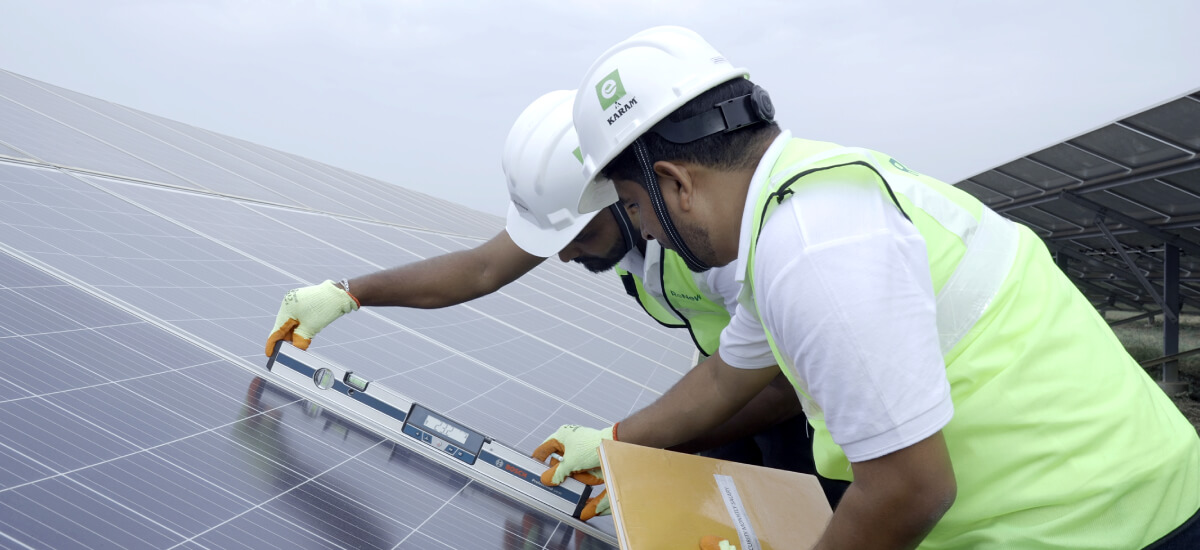
Technology has empowered us to harness solar energy for a bright and energy-efficient future. However, the success of harnessing this renewable power source hinges on the efficient installation of solar panels. The effectiveness of a good solar
Read More
The world is quickly shifting to renewable energy sources, with wind power emerging as a key contender in the fight against climate change. Global statistics and estimates for wind energy illustrate its enormous potential and crucial role in th
Read More